[Alumni Guest Post] Choose Wisely!

Tamara Frankel (PEP '09-'11) is in her second year of
teaching at Chicagoland Jewish High School.

tfIt’s one of the first sunny days in Chicago this spring and my students beg me to take them outside for class. We negotiate and decide to review our homework in class, on the board, and then go outside to start the next sugya. Eleven rambunctious and extremely insightful freshmen sit on the grass beside the bleachers while I stand up top. I ask my students to imagine that they are at the foot of Mount Sinai and that God is holding the mountain over their heads, expecting—maybe even threatening—them to accept the Torah. If not, they will die.
 
My students think I’m crazy. I tell them that Rav Avdimi recounts this dramatic “filling-in-the-gaps” of a pasuk in Shmot 19:17: “ויתיצבו בתחתית ההר”  “And they [the Israelites] stood at attention at the foot of the mountain”. For a moment, I’m off the hook; I could never make up this story! Continue reading
Share

Enlisting the Torah: My Encounter Trip Reflection

Our bus returned to Jerusalem an hour before Shabbat candle-lighting time. I quickly biked home to shower and light the candles before heading out to my friend’s place for dinner. It was only at twilight, while walking along the Rakevet (the old railroad tracks that cut across the south Jerusalem) and reading from a commentary on the week’s Torah potion, that some of what I had seen and experienced in the West Bank earlier that day started to come into focus. I was struck by the poignant connection between the week’s parsha and my day’s immersion into The Conflict.

398632_4407309425380_61578554_n

The passage was “Behar” in the book of Leviticus, which deals mainly with the laws surrounding the Shemitta (or Sabbatical Year) and the Yovel (or Jubilee Year). The Torah commands that every seven years the land is to lie fallow, and any fruits that the land produces by itself are to be shared equally with all. And after seven cycles of the Shemitta, or every fifty years, the Yovel is celebrated and all lands are to revert back to their ancestral owners. The commentary I was reading, written by Rabbi Michael Hattin in his book “Passages,” said that what we are to spiritually take away from this practice is that we must frequently “relax our grasp on the illusion of physical permanence that land possession affords.” Continue reading

Share

[PCJE Dvar Torah] From Desert to Dessert: a Shavuot Reflection – by Tani Cohen-Fraade

482032_653224635726_553887523_nIn Rabbi Meir Schewiger’s Parashat ha-Shavuah (weekly Torah Portion) class, while learning Sefer Shemot (Book of Exodus), we spoke about the desert as a place where one goes to prepare for Torah study. When B’nei Yisrael (Children of Israel) leave Egypt, they flee through the desert and are on the run until they get to Yam Suf (Red Sea) and cross to safety. Even after getting to Har Sinai (Mt. Sinai) and receiving the Torah, they still spend another 40 years in the desert wandering and preparing to enter into the Land. On the festival of Shavuot, we celebrate Zman Matan Torateinu (our receiving of the Torah at Sinai). We have just finished counting the Omer, the period of time from Pesach up to Shavuot and while we have now received the Torah and have celebrated this by a long night of learning and Torah study, B’nei Yisrael is still in the desert. For the rest of this year, leading up to the Yamim Noraim (Days of Awe) and Simchat Torah, we will continue to follow them as they travel through the wilderness in preparation for their entry into Eretz Yisrael (Land of Israel). I liked the idea of the desert as a place for preparation and when I thought back over the last few years of my life I began to like it even more.

In the fall of 2010, I had been living and working at home in Connecticut, teaching in the Jewish community for a year after graduating college and I was ready for a change. I volunteered with the Kibbutz Program Center and after consulting with friends of friends, was placed on Kibbutz Yahel in the very south of Israel, about a 40 minutes north of Eilat in a region called the Arrava. Arrava means wilderness and this was exactly what I found when I got there. This was the absolute middle of Continue reading

Share

Torah Balance

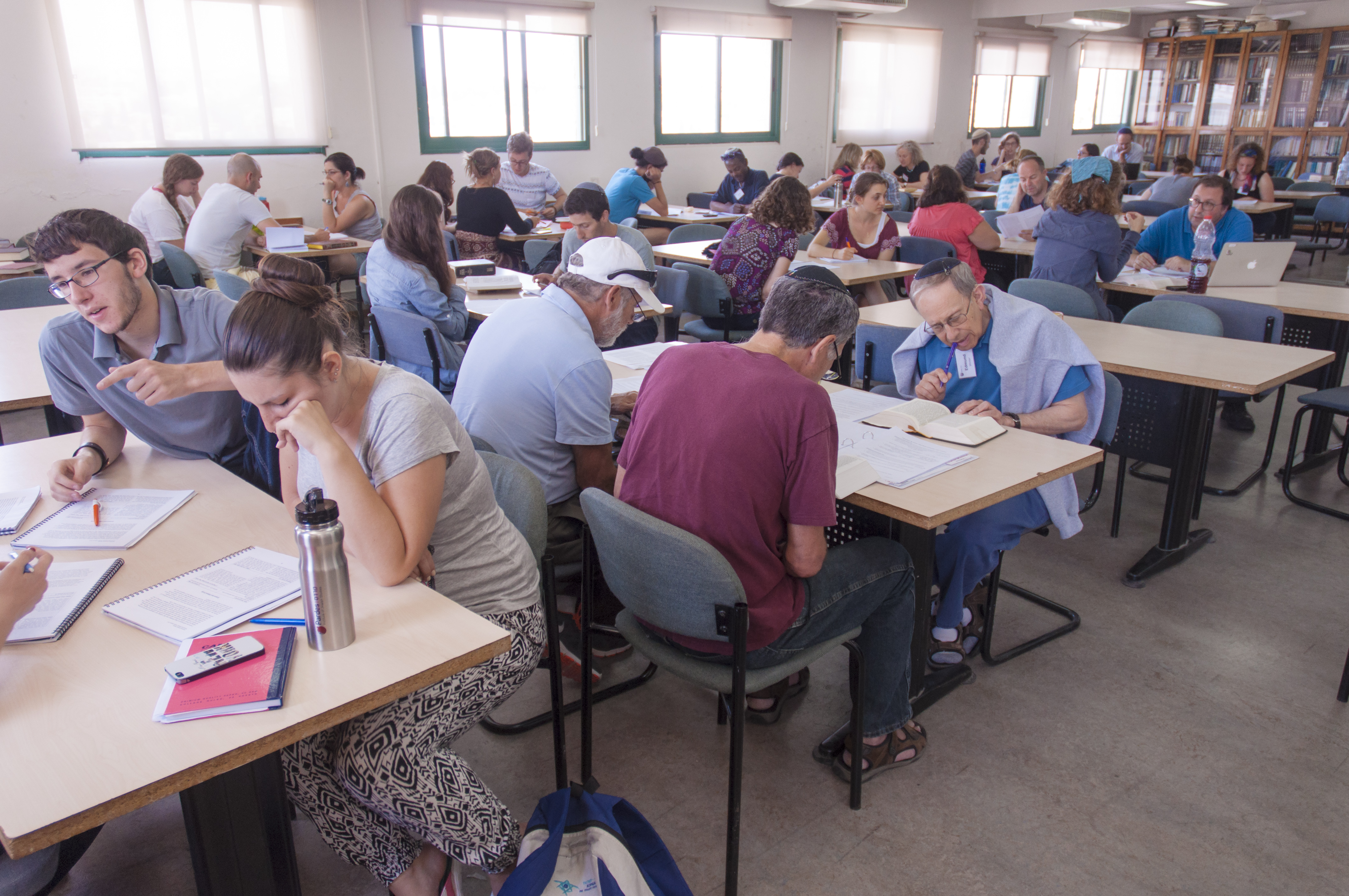
Yesterday was a special day at Pardes. Not because Meir was roaming the halls with a mass of students, singing at the top of his lungs, although that was part of it. Not because there was dancing in the beit midrash, although that was part of it as well. The occurrences above, while special, have been seen from time to time at Pardes before.

375086_10151567979563826_2073371638_nBut, this time, the spirited nigunnim sung in the halls and the circle dancing in the middle of the beit midrash were in celebration and commemoration of a Hachnasat Sefer Torah, the welcoming in of a Torah that was given to the Pardes community. This sefer torah was brought into our community with a number of meaningful rituals: It was brought, under the shade of a tallit, to every classroom where Torah was being learned that morning; it was escorted through the halls in which endless conversations referencing the impact of Torah study can be heard; and it was passed, from person to person, around the beit midrash, out to Continue reading

Share

Hachnasat Sefer Torah

Passing and imprinting on and from the new Pardes Sefer Torah

Passing and imprinting on and from the new Pardes Sefer Torah

Today at Pardes, we had the honour and the pleasure of dancing our new sefer Torah, (donated in honour of a recent Bat Mitzvah) around the school. We heard lovely divrei Torah from Pardes student, Dr. Aileen Heinberg and from Rav Landes. There was some mention made of the fact that a Hachnasat Sefer Torah is a brit and like at a brit milah, we stand for the ritual. Later, when we passed the Torah from one person to the next, I was reminded of a brit milah I attended years ago where the baby was passed from one family member to the next as he was brought into the room. Continue reading

Share

Dr. Micah Goodman: “What the Israeli elections teach us about Israeli society”

mgJust a couple weeks ago, Dr. Micah Goodman of the Ein Prat Academy visited us at Pardes to address the student body at shiur clali.

His insights into Israeli society were stimulating and refreshing. His analysis, based on the election results, that Israeli society is moving towards Jewish pluralism and openness was inspiring and very much complemented what I have been studying in my Modern Jewish Thought class. In that class, we have explored the tension between the particular and universal aspects of Judaism. Micah pointed out that as more secular Israelis learn Torah, Continue reading

Share

What is Torah to Me?

From my blog:

This piece is a response to a prompt by Melila Helner Eshed in a class at the Shalom Hartman Institute.

Stories within stories
Clamping shut and
Breaking open
With sharp, jagged edges
That draw blood
And push me back
So I stay at arm’s length

But inside, if I stretch the skin
Rolled open wide
There is sweet, healing water
And fire
In the spaces between the spaces
Of letters and crowns
I find queens, priestesses, mothers
Named and unnamed.

Torah is a gift of and for generations
And also a heavy burden
Shackles
Locked to wooden posts
Waiting for the hammerblow
That can transform them
Back into mirrors of guardians
Scrying bowls of temple keepers
Ink on skin.
Share

My Dvar on Mishpatim from Chabad House on Campus’ Student Shabbat 2011

The University of Pittsburgh’s Chabad House, run by two of my heroes, R. Shmuel and Sara Weinstein, is one of my favorite places on earth and one that has had an inestimable impact on my identity as a Jew. Once, when in late January 2011 they took a very rare Shabbat away, we students decided to take the opportunity to make Shabbat on our own. All the regulars took on different tasks; I volunteered to help set-up and give the dvar Torah below.


This week’s parsha is Mishpatim, or as its sometimes called, Where the Torah Starts to Get Really Boring, because this is the point where the Torah shifts abruptly from being about fantastic stories of our ancestors to being, except for Numbers, little else than lists of seemingly random laws. Even worse, this list comes immediately in the wake of the drama and excitement of the Revelation at Sinai—thunder, lightning, smoke, loud shofar blasts, the Voice of God, a nation trembling in fear, then…civil legislation! What gives?

Like any good speaker on Torah, I’m going to answer this question in a very roundabout way. Starting with this: Continue reading

Share

[PCJE Dvar Torah] Mishpatim: Seeing our Personal God (by Leah Kahn)

In last week’s Parsha, Yitro, we left B’nei Yisrael at Mt. Sinai, having just received the Ten Commandments directly from the mouth of God. Most would agree that they are reasonable commandments, which aim to help this newly freed people maintain order and positive values as a newly minted nation. Switching gears immediately from the pomp and circumstance of Yitro to the ostensibly mundane detailed laws of Parshat Mishpatim, we read of Moshe placing the laws before B’nei Yisrael: “And these are the laws that you [Moshe] shall place (תשים) before them.” (Ch 21:1). In a very straightforward manner, Rashi explains that Hashem commands Moshe to place the laws before the people, along with their explanations, just as one would set a table, with all its food ready for eating. In other words, Moshe’s responsibility is to make sure that each person knows the new laws and their underlying principles and meanings, so that the people would be able to apply them properly, and immediately, in various “halachic” situations. For two chapters, the Israelites are presented with dense legal information, and undertake the burdensome task of trying to learn and understand them. They must have been extremely inspired, for why else would they have invested so much time and effort to learning the new lay of the land? The exciting conversations that must have ensued probably sounded a lot like our Pardes Beit Midrash discussions, as the people tried to understand the new laws and their importance.


Then in Chapter 24, Moshe anoints the altar with the blood of a bull and throws the rest of the blood on the people. He reads the Book of the Covenant within earshot of the people, and they proclaim, ונשמע נעשה (we will listen and we will do). Mazal tov! You are now a people. One can almost see them stepping on a glass as the band starts up and the dancing begins. As Moshe, Aharon, Nadab, Abihu, and the seventy elders ascend Mt. Sinai to see God, B’nei Yisrael is left behind to process what has just transpired. Feasting commences, as the 11th verse states that, “…they gazed at God, yet they ate and drank.” According to Onkelos this feasting was favorable, as it enhanced the joy they felt upon seeing the visage of Hashem, and enabled them to physically enjoy the experience. Ramban also comments on what a significant spiritual privilege it was for the people to have been allowed by God to see their redeemer, the master of the universe.

But there seems to be a large imbalance in the Parsha. The Tanach spends two full chapters explaining the laws that B’nei Yisrael must learn in order to be a society, and only half a verse describing B’nei Yisrael looking and gazing upon God. How can such a noteworthy event get such little press? I believe there is a message for us in this purposeful inconsistency, that we modern, halachically-minded Jews should learn. Rules and laws are necessary in order to keep a society functioning through order and structure, that’s a given. As Rabbinic Jews though, we often times get very focused and caught up in the law without simultaneously turning enough of our “gaze” to God. All too often we forget to talk about not just God, but our vision of a personal God, and the status of our relationship with God. I imagine that after B’nei Yisrael sees God, they must have discussed their feelings about the experience to no end, and shared in the joy of this climactic Jewish historical event as a community. Yet the Torah doesn’t write about this.

I have shared a myriad of Shabbat meals with close friends and fellow Jews, the kind of meals that could only be created with an understanding and adherence to the laws of Shabbat. Out of all those Shabbatot, I can count on one hand the number of conversations I’ve had about personal concepts of God and the status of our relationship with God. As a community, I think we would benefit greatly if we learned to discuss our personal perception of the God we envision in our lives. Mishpatim tricks the reader into thinking that the emphasis is on law, when it actually wants to call our attention to B’nei Yisrael’s gazing on Hashem. By minimizing this part of the story, the Torah has actually maximized it. While we are clearly an extremely detail-oriented people, very focused on the laws, we need to remember to turn our focus towards God. By being in a relationship with God (however one defines God) the meaning of the laws maintain clarity and meaning in our lives. Without the infusion of spirituality within law, we run the risk of becoming empty followers who miss out on the bigger picture.

Share

[Alumni Guest Post] With Great Power Comes Great Responsibility

Ben Barer (Fellows '12) wrote a Torah reflection about Power and
Responsibility yesterday, in light of the Israeli elections:

While Spider-Man seems capable of handling the (great) power he is given, oftentimes we seem to fail most when power is in our hands. On this day, when democratic elections for the 19th Knesset of the Modern State of Israel will be tallied in the coming hours, I think it is appropriate to reflect on the Jewish People’s modern experiment with a great amount of power.

When the amount of time since Jews last had sovereignty on the scale that we do now is measured in millennia, one might think that the traditional sources of our tradition would be of little value. And while those sources do not talk about nuclear weapons, or democratic leadership, I think that Torah can still assist us in understanding the innate need for, and the dangers inherent in, accepting (voluntarily or otherwise) such power.

In Dvarim/Deuteronomy 17:14-15, Torah teaches us:

“When you come to the Land that Hashem your God is giving you, and you inherit and settle it, and you say ‘I will place a King over me like all the other nations that surround me.’ You may surely place a King over you, that Hashem your God will choose from amongst your brethren, Hashem will place a King…” (all translations mine)

What is interesting for me is Continue reading

Share