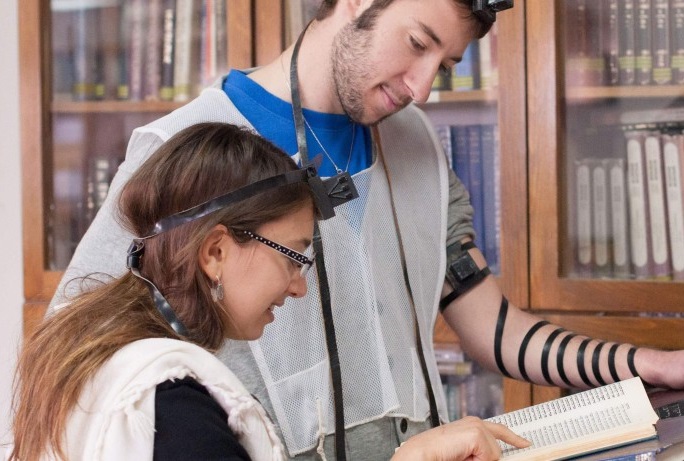
Rosh Chodesh Sivan 5773 at the Kotel

I went to the Kotel on Rosh Chodesh Sivan expecting to pray, and I did. I was surprised that I could focus on prayer in the volatile atmosphere; the hullabaloo made me concentrate even harder than usual. “Ozi v’zimrat Yah” never had greater meaning for me than it did on Friday morning as I stood with several hundred women and men on the Kotel plaza, praying for the welfare of the world in the new month of Sivan.

I came to welcome the month and to celebrate the new court ruling that allows women to pray in tallitot and tefillin at the wall. What a wonderful reason to rejoice: I could sing, dance, wear a tallit, and not fear arrest! Even though the government is discussing the Sharansky plan, I am convinced that the Women of the Wall need to continue to pray as they have for the last 25 years until a viable long-term plan is realized. Those who oppose my presence as a praying woman in a tallit do so because Continue reading

Share

Dr. Micah Goodman: “What the Israeli elections teach us about Israeli society”

mgJust a couple weeks ago, Dr. Micah Goodman of the Ein Prat Academy visited us at Pardes to address the student body at shiur clali.

His insights into Israeli society were stimulating and refreshing. His analysis, based on the election results, that Israeli society is moving towards Jewish pluralism and openness was inspiring and very much complemented what I have been studying in my Modern Jewish Thought class. In that class, we have explored the tension between the particular and universal aspects of Judaism. Micah pointed out that as more secular Israelis learn Torah, Continue reading

Share

[Alumni Guest Post] Ben Freedman — Building Upon my Pardes Experience

BF (2)The semester I spent at Pardes was among the most important periods of personal growth that I’ve ever had. Upon my return to the US, when family or friends would ask about it, I could only create impressions of how I had grown or what I had truly learned. I would say, “imagine six months of uplifting, inspiring, Jewish group therapy with 120 of the most engaging and supportive and genuinely caring individuals you’ve ever met.” Needless to say, that sort of explanation usually generated more confusion than clarification.

In an attempt to build upon my Pardes experience having moved back to Washington, DC, I began attending the DC Beit Midrash (DCBM), a welcoming, pluralistic and diverse learning community that meets every week at the DC JCC. I had heard about DCBM from my Pardes classmates and was curious to learn why they spoke so enthusiastically about the group. Continue reading

Share

[Student Profile] Aileen Heinberg

Aileen Heinberg grew up in a Modern Orthodox community in Brooklyn, NY, and graduated from the Yeshiva of Flatbush, which she’d attended since kindergarten; Torah learning was so woven into the fabric of her environment that she came to take it for granted.

Nevertheless, the young woman eventually grew to appreciate Jewish learning as a student at Columbia University, and elected to take several courses in Jewish studies, even as she pursued her psychology degree. In retrospect, she appreciated the emphasis that her yeshiva education had put on the Jewish value of chesed (kindness), as she volunteered very actively during her college years with Nightline Peer Counseling, Peace Games, and America Reads – serving both her local and extended communities.

At Columbia, Professor Walter Mischel strengthened Aileen’s thirst for exploration; she became more excited about research, learning and teaching, as she observed him during class and worked in his lab after college graduation. She wrote her honors thesis on learning strategies, and became interested in how to shape children’s positive development. After college, she also worked on projects involving child and adolescent psychology at the Columbia Health Sciences Center, and two years later she began a doctoral program in psychology at UCLA.
Continue reading

Share

Community Davening at Pardes

A high-five across the mechitza when the tenth woman walks in.

Women’s liberation and Orthodox Judaism together, to some of my friends, sound like an oxymoron. Some argue that a legal system that doesn’t count women for thrice-daily prayer is inherently unequal. Others argue that to compromise an incredibly sustainable tradition that has weathered three thousand years for the sake of the trends of the last fifty years wounds the integrity and future of Judaism. How do we balance amidst this tension?

A high-five when the tenth woman walks in – really, whan any woman walks in – is a scene I have never seen in a traditional Orthodox minyan. I was walking by a synagogue just the other week and was asked to join a minyan for kaddish. That’s because I am a man, so I count. But the room holding its breath, waiting for one more woman – I had never seen that happen before in Orthodox space. I am proud that we have been able to create just such a space at Pardes where it does.

Continue reading

Share

Bipartisanship

Too often bipartisanship is equated with centrism or deal cutting. Bipartisanship is not the opposite of principle. One can be very conservative or very liberal and still have a bipartisan mindset. Such a mindset acknowledges that the other party is also patriotic and may have some good ideas. It acknowledges that national unity is important, and that aggressive partisanship deepens cynicism, sharpens political vendettas, and depletes the national reserve of good will that is critical to our survival in hard times.

-Richard Lugar, U.S. Senator (R, IN)

Following the trend of the U.S. Senate (and all of Congress, for that matter), Senator Richard Lugar was voted out by his own party last week – after serving in the U.S. Senate for 36 years. The quote above is from Senator Lugar’s exit letter, dated May 8th (one week ago today).

This letter resonated deeply with me, and as I read it my thoughts turned to the Jewish nation – if there’s one overarching lesson that I’ve derived from my studies at Pardes, it’s surely the lesson of Ahavat Yisrael… the lesson that we Jews should strive to “have a bipartisan mindset… (and) acknowledge… that (others are) also patriotic and may have some good ideas… (that) national unity is important.”

Insert the word ‘pluralistic’ for ‘bipartisan’, and I find that Senator Lugar’s approach to politics suggests a healthy and productive framework for the Jewish nation to chart a unified course through the divisive currents of change and uncertainty.

Share

Week 36: From Silence to Song

(Mostly X-posted from my home blog, Yinzer in Yerushalayim)

The weekend before last was the retreat Shabbaton for Self, Soul, and Text class at Kibbutz Hanaton, our teacher James’ home, in the Galil. The schedules Friday and Saturday were nearly identical, each day going like: 9-9:45: Sit. 9:45-10:30: Walk. 10:30-11:15: Sit. 11:15-12:30: Lunch. 12:30-1:15-Sit. It was brutal, and that’s no joke, since “Sit” didn’t mean “Lay on a couch, go on your computer, and schmooze,” it meant, “Sit upright in the big white tent like the kind we use in Pittsburgh as the Game Day Live Tent at Heinz Field for 45 minutes, focus on your breathing, or, if your nose is too stuffy to make that even remotely relaxing, then on the feeling of your butt in the cushion and try to meditate without thinking of scenes from The Simpsons.” and “Walk” didn’t mean “Go for a stroll on the beautiful grounds of the Kibbutz,” it meant “Slowly pace back-and-forth over the same 10 feet of ground, trying to focus on your steps and breathing without humming the Red Hot Chili Peppers song in your head. The hardest part of this was that we couldn’t hike: Hanaton is a gorgeous place, with birds singing everywhere, that kibbutz smell (read: cow dung) in the air, rolling green hills and farmland, a huge clear sky showing Omnimax sunrises and sunsets twice-daily, and a Druze village in the distance, and the nearest source of water was the reservoir in the distance sealed-off with barbed-wire; all we could do, however, is see everything from a distance. Meals offered no escape either, since this was a “silent” retreat, and by “silent,” they mean “lonely:” there was no talking, touching, looking, or even smiling at your friends from Thursday night until Saturday night. As I said, it was absolutely unforgiving. When we weren’t Sitting or Walking or praying, we were usually either listening to an excellent class by James, meeting with him privately, or singing niggunim with him. Friday afternoon, we all went to the mikveh.

Continue reading

Share

[Student Profile] Stu Jacobs

“I’m very adamant about a pluralistic model of Jewish practice.”
-Stu Jacobs

In 5th grade, a teacher inspired Stu Jacobs to explore and gradually start keeping more mitzvot, and throughout his youth the young man strived to connect to and practice a new mitzvah every single year. His teacher had said that ‘he didn’t have to jump into the deep end’ – he could try out different practices to see if they appealed to him – and Stu still recalls his childhood mentor as a factor in his decision to become a Jewish educator.

Stu decided to return to his Solomon Schechter Day School in 8th grade despite the tiny class size, and it turned out to be a great year for him. The school offered very traditional Judaic studies, and a modern, egalitarian approach to Judaism. He grew in terms of leadership, learning and friendship, and was only disappointed in the school’s lack of a Talmud curriculum… the young man’s itch to study Talmud only increased as he approached college.

Raised in a traditional Jewish household, leading Shabbat services and reading Torah at the Beachwood Kehilla, and attending Jewish day school until high school, it was natural for Stu to attend the Alexander Muss High School (AMHSI) in Israel during the summer before his senior year of high school. It was a formative experience; through that program Stu developed an even deeper connection to Jewish history and the land of Israel, and he would return to AMHSI as a madrich (counselor) during the summer before his senior year at the University of Michigan.

After Judaism, Stu’s greatest passion was for cooking and working in the restaurant industry. He had been cooking for fun since the age of twelve, interned under a pastry chef at a fine dining establishment during senior year of high school, and continued working in restaurants during his summers as bus boy, waiter, and restaurant management intern. He even arranged his organizational psychology major in such a way as to prepare himself for a career in the restaurant industry.

Before embarking on his career after college, Stu wanted to work at AMHSI once more for a whole semester – a role that required a more skilled madrich – but after the bombing at Hebrew University in 2002, most parents pulled their kids out of the program… and Stu had to look for another way to get himself to Israel.

When the young man heard of Pardes from a friend, a light went off in his mind, and he recalled his itch for Talmud study. He arrived before Yom Kippur, and after his first semester he decided to remain at Pardes for the rest of the year. Rabbi Aryeh Ben David was Stu’s Talmud instructor, and he recalls attending one of Rabbi Ben David’s very first spirituality retreats – a precursor to his mentor’s unique, spiritual ‘Ayeka’ organization. That year, Rabbi Ben David suggested that Stu consider joining the Pardes Educators Program (PEP), but the young man still wanted to pursue a career in the restaurant industry.

Happily for Stu, he began dating his wife Aviva that year while she was a Dorot Fellow, and they maintained a long distance relationship for the following year while he worked as restaurant manager and catering director at a kosher café in Manhattan and she remained in Israel to work for the Nativ program. Finally, Aviva moved to NYC in 2004, and the young couple was married in early 2006.

After four years of working for a family operated catering business, Stu gradually realized that the he didn’t want such a hectic life for his future family. When Aviva began her doctoral program in psychology in 2007, and they moved to San Francisco, Stu was recruited by a PEP alum to become the new head of food service at the Jewish Community High School of the Bay (JCHS) . At JCHS, Stu also became the assistant head coach of the varsity basketball team, and led annual week-long class trips for the students. Another PEP alum on the JCHS Judaic studies faculty mentored Stu for an entire school year, and, towards the end of that year, he was given the opportunity to teach a unit on King David and Bathsheba to the juniors and seniors.

Recalling his time at Pardes, Stu already had an interest in becoming a Jewish educator, and he came back for the Summer Program of 2008 with the same good friend who had introduced him to Aviva. Learning at Pardes, working at JCHS, and the young couple’s heavy involvement in the Mission Minyan (an independent minyan) all whetted Stu’s desire to enroll in the PEP program… and when Aviva completed her class work in 2011, the young couple and their daughter Elinoa (born May 31, 2010), moved to Jerusalem so that Stu could pursue his dream - to feed inspire future generations of Jewish day school students! :)

Stu, Aviva & Elinoa! Cute!
Share

An Egalitarian Minyan in Hebron

Last weekend, I spent a lovely Shabbat in the holy city of Hevron.  What a place!

The four Pardesniks that went were a tour de force of “peace and conflict.”  Personally, I made it my duty to wear a huge smile and say hello to every person I happened across, be they Jew, Arab or European observer.  The laughs were endless!

Perhaps my favorite part of visiting Hevron, as well as the primary reason why it’s so important for Jews to live there, is going to the Cave of the Patriarchs.  It’s such a holy feeling, when you finish davening and you can be blessed through the memories o f the Avot and Immahot.  Not suprisingly, most of the davening that happens in Hevron occurs at Machpelah.  I mean, why daven anywhere else?  A shul in Hevron is about as useless as a shul in the Old City.  And, let me tell you, the davening was pretty sick.  The Kabbalat Shabbat service there was among the best Carlebach services I have ever attended.  Those zealots make the guys at Mizmor L’David seem asleep.  And it was perhaps my proudest moment, before Lecha Dodi, when I assumed the role of honorary snuff guy at the Machpela.  That itself was worth the trip.

I’ll be honest, though.  Hevron isn’t the paradise we make it out to be.  They’ve got a serious problem, and my hope here is to address it and make inroads to solving it.  The problem of which I am speaking, of course, is the lack of egalitarian davening at Machpelah.  Jerusalem has made modest inroads in this regard, with the Masorti Kotel and the courageous Women of the Wall.  At Machpelah, which attracts hundreds of visitors a week, the issue has never been brought up, as far as I am aware.  Like the Kotel, Machpelah belongs to all Jews, not only the Orthodox establishment.  It is an embarassment to the democracy of the State of Israel that one of our holiest sites cannot be religiously pluralistic.

For these reasons, I conceived of the idea for an egalitarian minyan in Hevron, but I can’t do it alone.  I need the help of at least 9 brave Jewish men and women (probably more to ensure attendance) to help me place facts on the ground in the Hevron community and stand up to the coercive pressure of the Orthodox.  I haven’t decided on a name yet, and I’m open to suggestions.  So far, I’ve thought of Conservatives at the Cave, Masorti b’Machpela, or Hevron Shivioni.

Now, at this point, you’re probably saying to yourself, “Rob, those Hevron people are crazy.  Try starting an egalitarian minyan at Machpelah, and they’ll shoot you.”

That brings me to the secret ingredient to my plan.  What we will need to do to achieve our goals is to balance our religious moderation with a nationalism so strong and violent that the other Hevron residents (including the army and police) will be afraid of us.

How do we do that?

The first move is to establish for ourselves a base of action, our “settlement within a settlement.”  There are plenty of houses in H-2 that are vacant because their “owners” “fled.”  My plan is, through extra-legal means, to occupy and establish residency in those buildings and immediately initiate a wave of violence against the local Arab population.  To describe an analogous situation, think of a new inmate’s first night in maximum-security prison.  It is absolutely vital that, on that first night, he beats someone within an inch of his life so that the more established inmates don’t get any ideas in the shower.  It’s the same idea here.  The Orthodox establishment will a) most likely support us in our campaign of violence, and b) become frightened of us with the extent of our attacks.  All they’ll be able to say is, “They’re a bunch of heretics, but they make us look like Meretz.”

Our new status in the Hevron community, then, will give us a leg to stand on vis-à-vis organizing egalitarian davening at Machpela.  We will start small, with davening on the steps outside of Machpelah like Jews of old used to do (which we could name the Madrega (stairs) Minyan), and, through threats of violence and armed negotiations, we will begin sharing Machpela and having weekly, Shabbat, and holiday services on a rotating basis.

This is a holy mission we are setting out to accomplish here.  We are taking ownership of one of our most sacred sites through the model of religious moderation.  Who’s with me?

Share

Week 20: The Arava Tiyyul

(X-posted from my home blog, Yinzer in Yerushalayim)

Tuesday through Thursday those of us who didn’t go on the annual Poland trip went on a tiyyul to the Arava. The Arava is a huge rift valley south of the Dead Sea split between Israel and Jordan. Similar to the Negev tiyyul, our primary activities on this tiyyul were hiking, learning about our surroundings, and eating cookies. This time, however, we stayed at Kibbutz Ketura, built on the site of a former military compound almost right along the Jordanian border. Another difference was the people—not only was half the school in Poland, but we were joined by many of the new students for this semester.

It turns out there are few better ways of getting to know new people than by hiking with them. Seeing the new people choose the hard or easy hike, how they conducted themselves on the bus and in the dining hall, what they wore and the kinds of conversations they made during the hike, what kind of cookies they prefer, and how they are as roommates all made much better ways of judging getting to know them than any superficial ice-breaker game ever could have. Of course we played one of those, too—where we all sat in a circle, dug deep within ourselves, and put our ability to properly throw a football on display before the entire group, some of whom we barely knew. Many tears were shed; a few noses were almost broken, but by the end of this intimate exercise, we emerged as a team, closer than ever before. The new kids are awesome.

We began the tiyyul on the limestone sand dunes, a unique geological feature of the Negev. These sand dunes contain some of the finest sand in the world—you can run, roll and jump through it like snow. And we did. Even now, three days later, I’m still brushing it out of my hair, ears, phone, and wallet, but it was worth it.

Following this, those of us on the hard hike trekked five hours from there to the kibbutz, stopping only once every hour or so to eat cookies, while, from what I hear those on the easy hike saw a rather disappointing Leopard Temple.

Wednesday I did the hard 5-hour hike up Har Amir, which contained only a roughly once every 45 minutes cookie-break plus a hybrid lunch/cookie break at the summit.

After the hike, both groups met-up to go to Eilat, about a half-hour drive away. I had never been to Eilat before, and I found that it lived up to the hype of combining the class of the Atlantic City boardwalk with the ambiance of Breezewood.

I shouldn’t complain, there’s some parts of Eilat I really loved: there’s no VAT in the entire city, and at the Gap in the mall, I got a great new pair of jeans and a belt for WAY less than I could have at any store in Jerusalem. It was so cheap in fact that I think the next time I need clothes, if not for the large amount of time it takes to get there, it would be more cost-effective to buy a bus ticket to Eilat and do all my shopping there. Actually, even with the travel time, I would much prefer this to going to the Shuk on a Friday,

Thursday, I did the hard hike up Har Timna, then the even harder hike back down. Unlike the previous two hikes, this one was only four hours long, including at least two cookie-breaks and a food-break on top of the mountain.

We then saw “Solomon’s Pillars” in the Timna Valley.


Wednesday night we had a presentation about the Kibbutz then Thursday after lunch we got a tour of it. Ketura is an amazing, inspiring place, and its location is the least of reasons why. It was founded by American Young-Judea alumni in the 1970s and has since grown into one of the largest and most successful kibbutzim in Israel and features members from all over the world. Far from just date and dairy farming, they’ve also built a state-of-the-art algae farm, Israel’s first solar field, the lovely resort hotel in which we stayed, hiking tours with a very knowledgeable and friendly staff that guided us through our hikes, and the renowned Arava Institute for Environmental Studies—a school where Israeli, Palestinian, Jordanian, other Arab, and even some North American and European students learn everything from public-policy to water management to peace-building skills. Impressive as all this is, though, I think the biggest reason Pardes comes here every year is for its unique model of Jewish religious pluralism among kibbutzim. The kitchen is kosher, Shabbat and holidays are officially observed, and there is a synagogue where Shabbat services, B’nai Mitzvot, and circumcisions are held. Yet inside people’s homes there is religious autonomy; in private, some people are Orthodox, most are what we would call Conservative, and some are secular.

Ketura made me realize that before this week, I had no real idea what a kibbutz actually was. Prior to this, I always pictured a kibbutz as basically a farm full of ben Gurion-era socialists, but now I know that’s not entirely true. Yes, 100% of all members’ salaries go into the kibbutz and almost all meals are eaten together in the main dining hall, but children live with their families and you can eat at home any time you want to. Members are encouraged to develop their own projects suited to their needs and talents. I think our presenter Wednesday night was right when she said the kibbutz model is actually democracy in its purest form since all decisions on the kibbutz are made by committees of members, meaning all decisions made effect the decision makers equally as much as everybody else. As our tour guide said, nobody’s about to set-up a tent outside the kibbutz conference room. Very much like the Jerusalem bi-(really tri-)lingual school and the State of Israel as a whole, I am tremendously happy such a place exists, even if I can’t see myself living there.

Currently, the most famous resident of Ketura might be Methuselah, a 5-year old date palm. This plant is guarded as least as heavily as the Mona Lisa at the Kibbutz, and for good reason: It is the world’s oldest 5-year-old, growing from a 2,000-year-old seed of the now-extinct Judean palm variety found atop Masada. Other seeds were found, but this was the only one that still worked. Unfortunately, Methuselah is a male tree, so it will not be able to produce fruit without a female seed. Since I majored in fiction writing and not botany, I have no idea what that means other than what our tour guide said, “We have to find Methuselah a girlfriend.” I smell a reality show…

A 2,000-year-old date seed from Masada growing in the desert soil of a kibbutz in modern Israel. I bet you could make a lot of metaphors out of that.


Quote of the Week: “Earth’s crammed with heaven/And every common bush afire with God: But only he who sees, takes off his shoes,”- Elizabeth Barrett Browning as quoted by our dean, Dr. Bernstein


Hebrew Word of the Week: עוגיות (“oogioht”) – cookies


(Top two photos stolen from Austin Clar and Yishai Paquin, respectively. Bottom one stolen from Andrea Wiese.)

Share